Why 63% of Small Businesses Have Less Than 3 Months of Cash — And What That Means for You
A February 2026 survey of 307 U.S. owners found a hard number. 62.9% hold fewer than 90 days of operating cash. One-third have less than 30 days.
You feel it before you see the report.
The Numbers Behind the Pressure
Revenue-to-expense ratios are barely above 100%. Payroll outflows rose 10% last quarter. Fixed obligations hit a two-year high.
When an unexpected $10,000 expense lands, 76.2% of owners say they do not have the cash to absorb it. Only 23.8% can cover it from reserves.
Funding is not the luxury option. For many owners, it is the gap between operating and closing.
Quick comparison.
|| Bank Loan Timeline | Alternative Funding Timeline | ||---|---| | Apply | 20-60 min paperwork | 5 min, one page | | Qualify | Credit 680+, 3 years tax | Revenue-based, 500+ OK | | Approve | 30-90 days | Under 4 hours | | Funds | Weeks after approval | Within 24 hours |
Sources: Revenued Q1 2026 SMB Report; OnDeck Q3 2026 Cash Flow Trends; Ocrolus K-Shaped SMB Lending 2026.
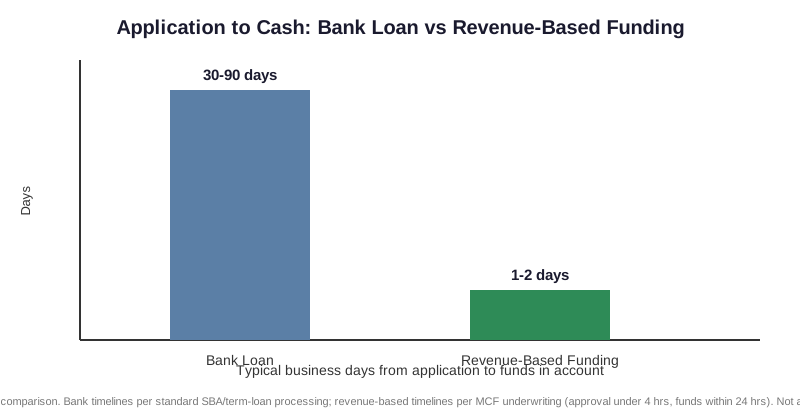
Image note: Conceptual timeline chart based on aggregated application timelines. Actual timelines vary by lender and applicant profile.
What Works When Banks Say No
Construction owners funded at 44.0% in 2026 application data. Restaurants at 31.4%. Trucking at 32.3%. All roughly double typical bank approval rates for the same segments.
Revenue-based underwriting reads deposit patterns where bank models see risk labels. That difference shows up in real numbers.
Average funded amounts (2026 applications, real data):
- Construction & trades: $52,235
- Medical & healthcare: $61,187
- Trucking & transportation: $29,610
- Restaurants & food service: $19,738
- Professional services: $37,086
Source: Fundmerica Small Business Funding Report 2026 (Jan 1 – Jul 26, 2026, 6,440 applications).
Where Cash Goes First
Cash flow stress does not hit evenly. Construction waits 60+ days for progress payments. Restaurants run on 11-day median reserves. Trucking pays fuel today and collects broker invoices in 30-45 days.
Every vertical has a different gap. The right funding tool matches that gap, not a generic loan category.
Frequently Asked Questions
How much funding can I actually qualify for?
Most owners qualify for 10-20% of monthly deposit volume. A business depositing $50,000 per month typically sees $50,000-$100,000 in available funding.
Does my credit score block approval?
No. Revenue-based qualification focuses on bank deposits, not credit scores. Owners with scores in the 500s receive approvals when revenue supports it.
What documents are required?
Four months of bank statements, a one-page application, government-issued ID, and a voided business check. No tax returns. No business plan.
How fast can the money reach my account?
Most approvals complete in under 4 hours. Funds typically hit within 24 hours of approval. The full process takes less than 48 hours for most owners.
Ready to see what you qualify for? Apply for Revenue-Based Funding — Get Your Free Quote → or call (888) 562-1119.
Related Posts (all MCF funding paths)
- Merchant Cash Advance — Apply in 5 Minutes
- Bridge Loans — 7-15 Day Close
- DSCR Loans — No Tax Returns
- Revenue-Based Financing Guide
- Call (888) 562-1119 — Free Quote Over the Phone
Related Posts (existing)
Related Guides
Small Businesses Buy the Holiday Discount in September. Working Capital Is How They Pay for It
The volume discount your supplier offered in October is gone by December. Working capital is what lets a small business put cash down while the discount still exists, and fund the marketing that moves the inventory.
Enova Killed Its Bank Deal — And Small Businesses Are Better Off for It
Enova International walked away from a $369 million bank acquisition this week. Here's why that matters to every small business owner who borrows money — and why letting a fintech become a bank would have made things worse, not better.
5 Reasons Small Fleets Run Out of Cash Between Loads
Freight pays late, fuel bills do not. The five cash-flow failures that push small trucking operations into a funding conversation.