When Banks Take 60 Days: How Real Estate Owners Close in 7 — 2026
SBA SOP 50 10 8.1, effective October 1 2026, changed the math for acquisition loans. The DSCR floor for first-time buyers moved to 1.25x — based only on historical earnings, not projections. Every deal now requires a full valuation. The streamlined $350K shortcut is gone.
Your closing window does not change with the rules.
What the Timeline Actually Looks Like
A standard SBA 7(a) acquisition takes 60 to 90 days from application to closing. A 504 deal runs 45 to 60 days — faster than 7(a), still slower than most rate-lock windows.
|| Funding Path | Typical Close Timeline | Key Requirement | ||---|---|---| | SBA 7(a) Acquisition | 60-90 days | DSCR 1.25x, historical earnings only | | SBA 504 | 45-60 days | Full underwriting, valuation required | | Hard-Money Bridge (MCF) | 7-15 days | Revenue + property value | | DSCR Loan (MCF) | 7-15 days | Rent roll + 620+ FICO |
That gap — 60 days versus 7 — is not an abstract comparison. It is a deal term.
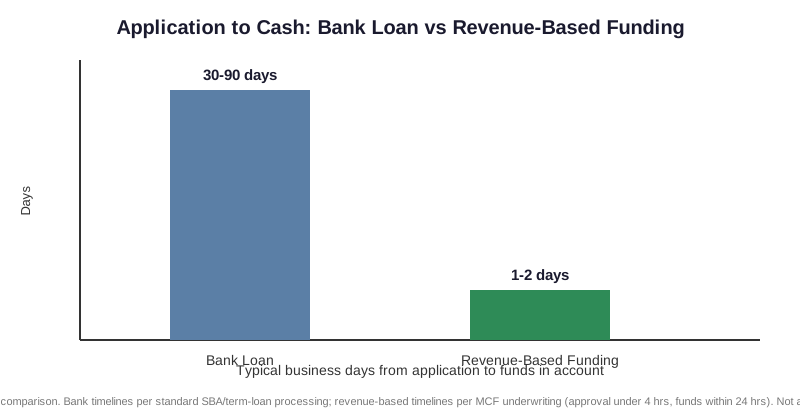
Image note: Conceptual framework based on SBA SOP 50 10 8.1 timelines (Polsky Center 2026) vs MCF site terms ($115K-$8M, 620+ FICO, 7-15 days, 40-state coverage). Actual close times vary by deal, state, and title status. Not a guarantee of approval or timeline.
Why 7-Day Closes Require a Different Path
When a contract has a hard close date — a rate-lock expiring, a seller with a backup offer, a 1031 exchange window — the underwriting model matters more than the rate.
Revenue-based underwriting reads property value and current revenue, not three years of SBA-compliant tax returns. Hard-money and DSCR products close faster because the documentation load is smaller. The trade-off: a factor rate or bridge fee instead of a bank rate. When the deal's return exceeds that cost, the faster close pays for itself.
When a faster path fits:
- You have a signed purchase agreement with a closing date under 30 days.
- Your SBA timeline extends past the seller's deadline.
- You need to preserve a rate-lock or tax-deferral window.
- The property produces or will produce revenue — DSCR underwriting applies.
When it does not:
- You have 60+ days before closing and the seller accepts SBA timelines.
- The deal's return does not justify a premium rate.
- No property or revenue exists yet — new construction without permits or contracts.
The Numbers Behind the Gap
Since October 1, SBA acquisition lending volume is down double digits year-over-year: 56,130 7(a) loans ($32.4B) and 504 down 9% to $7.1B. Independent valuations and quality-of-earnings requirements add time and cost to every file.
That does not mean the deal stops. It means the funding source changes.
Frequently Asked Questions
How fast can a hard-money bridge close?
Most close in 7 to 15 days from application. Some files with clean title and existing appraisal close faster. Your actual timeline depends on title, appraisal, and property condition.
What FICO score is required?
DSCR products start at 620. Hard-money bridge loans focus more on property value and deal structure than on score. Revenue-based underwriting applies.
Is this a replacement for SBA 7(a) or 504?
No. These are faster, shorter-term paths. They work best when a closing window does not allow SBA timelines — acquisitions, refinances, or contract-driven purchases.
What amounts are available?
From $115,000 to $8,000,000, depending on deal, property value, LTV, and experience. 90% LTC available on some products. 40-state coverage.
Does MCF fund construction loans too?
Yes. Construction equipment, mobilization, and bridge funding for delayed progress payments — all within the same 7-15 day framework.
Your closing timeline is a deal term. For acquisitions that need a 7-to-15-day path — especially with SBA timelines tighter since October 1 — Get Your Free Quote → or call (888) 562-1119.
Related MCF Funding Paths
Related Guides
Commercial Real Estate Financing: The Two Programs That Actually Fund Deals in 2026
Real CRE financing criteria for 2026 — application-only bank programs to $1M at 50% LTV with no income docs, and private-lender bridge/hard money from $115K–$8M closing in 7–15 days. No generic advice.
Hard Money LTV: How Property Valuation Dictates Your Real Estate Loan
How LTV, valuation method, and property type determine your private loan size at MCF. Fix & flip, bridge, DSCR, construction. 40+ states.
Small Commercial Real Estate Loans Under $1M
Deals under a million dollars get skipped by banks and servicers. Where small-balance commercial financing actually comes from, and what it costs.