My Commercial Funding Weekly Housing Report — Oct 7, 2026
Friday's jobs number came in at 29,000. The forecast called for 90,000. Unemployment ticked up to 4.2%, and the household survey went the same direction it's been going for months.
I've been in the funding business a long time, and a miss that size used to be the kind of thing that froze a pipeline for a week. This time the market took it in stride, rallied, and moved on by Monday afternoon. That reaction tells you more than the number itself did. Expectations were already sitting on a cut. The labor market just confirmed it, and confirmation rallies harder than hope does.
If you lend money, borrow money, or sell houses, that's the setup for the next two months. The Fed has the excuse it needed. What you do with the window between now and the end of the year is where the money gets made.
The week in plain English
Tuesday started quiet and turned out to be the most important day nobody talked about. Case-Shiller came in at 2.5% year over year against 2.2% expected. Home prices are still rising, and rising faster than the street figured. Every agent I talk to has the same story from their buyer pool: people are waiting for a pullback that isn't coming. Case-Shiller says they can keep waiting, at a cost.
Same morning, JOLTS came in soft at 7.079M against 7.23M expected. Job openings are draining. Consumer confidence dropped to 81.9 from 89.2, which is a big single-month move and mostly noise in the details, but it does tell you households feel worse than the hard data justifies.
Wednesday was the opposite. ADP private payrolls hit 90K against 70K expected, so the private side of the economy was still hiring. GDP came in at 2.2% against 1.5% expected, comfortably above trend. Core PCE, the Fed's actual inflation gauge, cooled to 3.0% from 3.3%. And Chicago PMI jumped to 58.8 from 51.2, which puts manufacturing in expansion for the first time in a while.
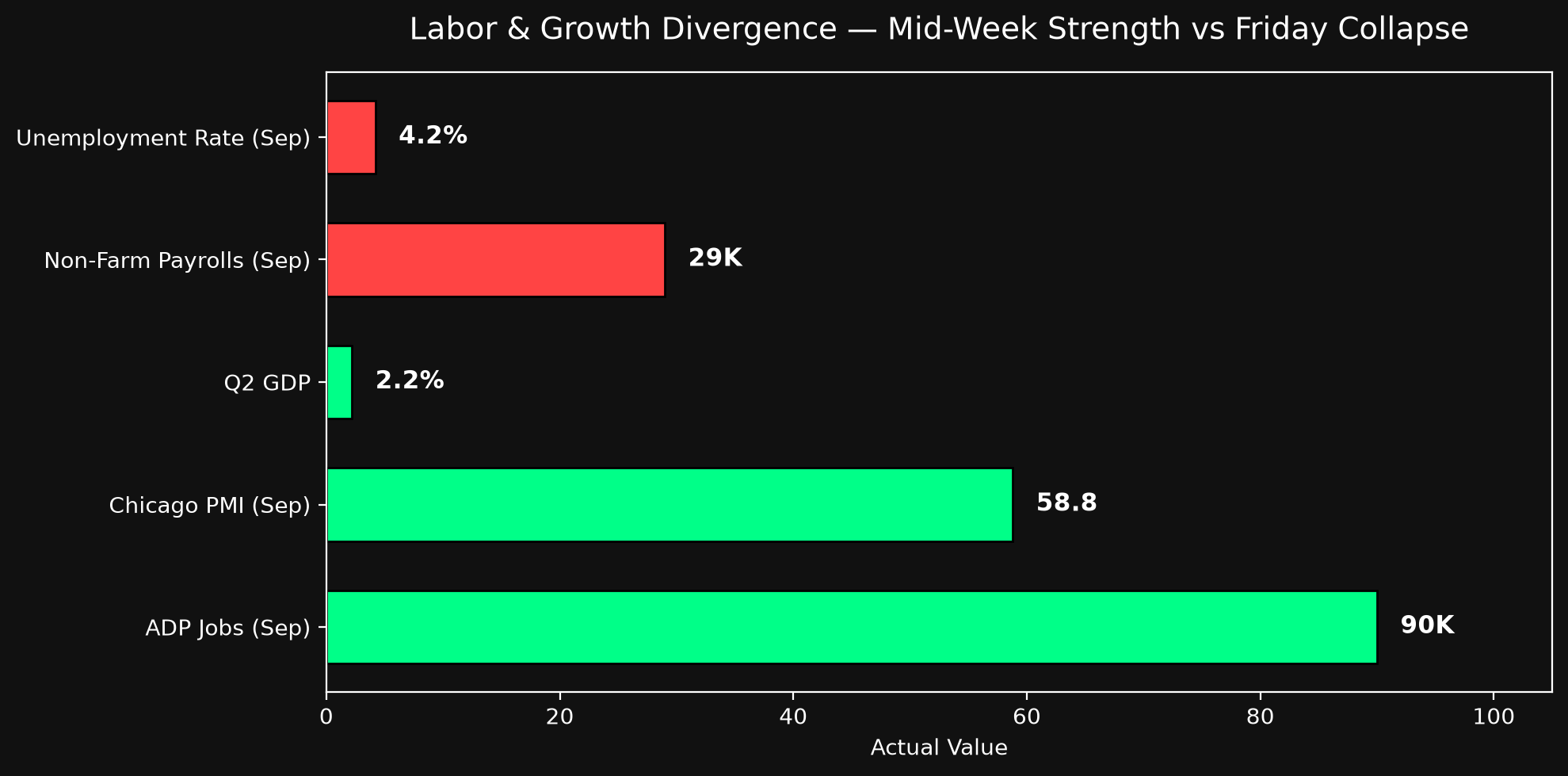
Read those together: growth above trend, inflation falling, factories expanding, and the labor market rolling over. That's the soft landing the Fed has been selling, except the landing strip just got shorter than expected.
Friday finished it. Non-farm payrolls at 29K against a 90K forecast, unemployment at 4.2% versus 4.1%.
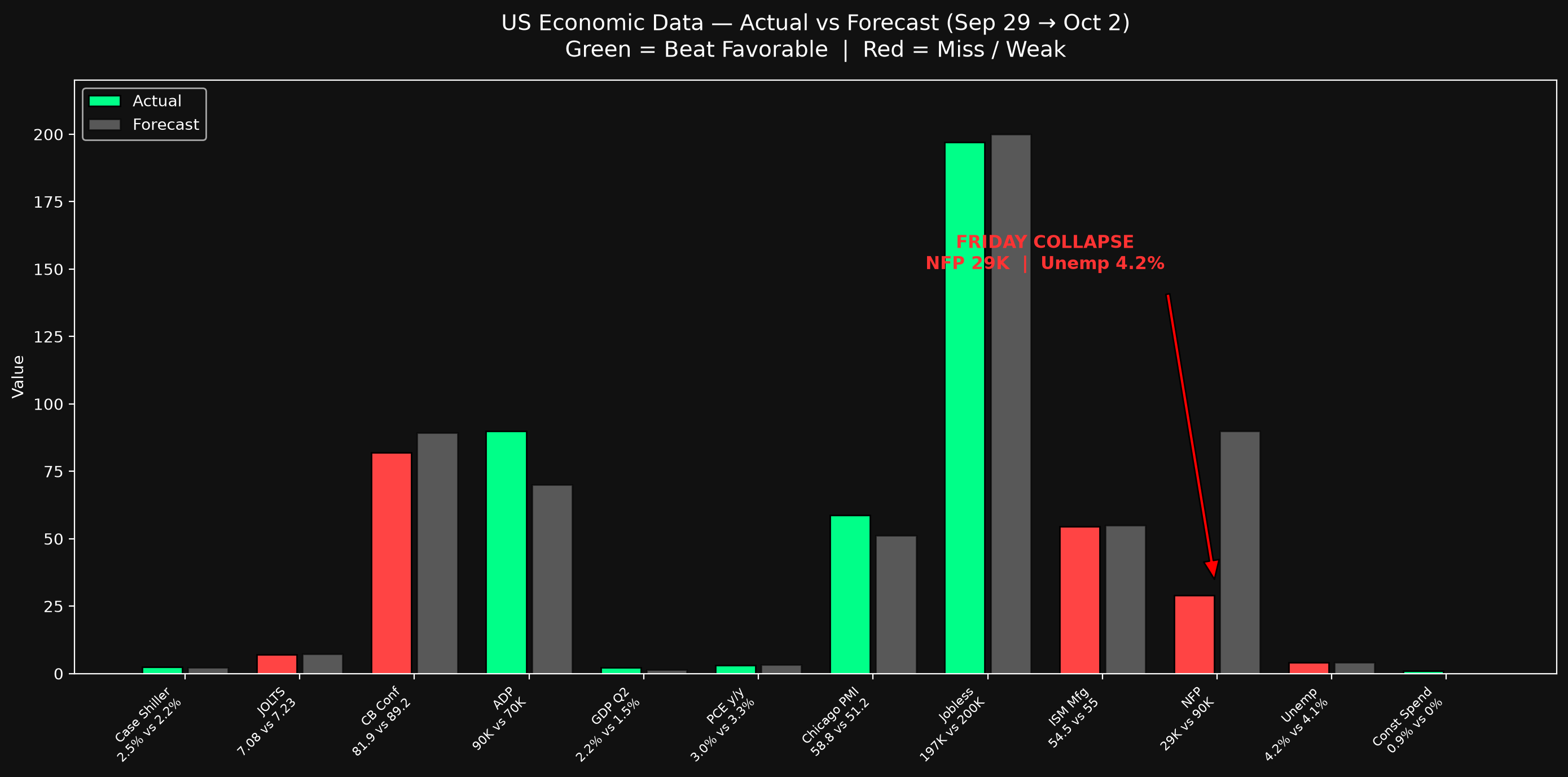
| Date | Report | Actual | Forecast | Read |
|---|---|---|---|---|
| Tue 9/29 | Case-Shiller (y/y) | 2.5% | 2.2% | Prices still rising |
| Tue 9/29 | JOLTS | 7.079M | 7.23M | Labor demand softening |
| Tue 9/29 | Consumer Confidence | 81.9 | 89.2 | Households pulling back |
| Wed 9/30 | ADP Payrolls | 90K | 70K | Private hiring held up |
| Wed 9/30 | GDP (Q2) | 2.2% | 1.5% | Growth above trend |
| Wed 9/30 | Core PCE (y/y) | 3.0% | 3.3% | Inflation cooling |
| Wed 9/30 | Chicago PMI | 58.8 | 51.2 | Manufacturing expanding |
| Fri 10/2 | Non-Farm Payrolls | 29K | 90K | Major miss |
| Fri 10/2 | Unemployment | 4.2% | 4.1% | Cracks forming |
What this does to housing
Mortgage rates don't move on the Fed's decision. They move on where the 10-year Treasury trades, and the 10-year trades on what the Fed is expected to do over the next six quarters. Friday pushed that expectation forward. Money that was pricing one cut in December is now pricing cuts sooner and deeper. Watch the 30-year follow it down over the next few weeks, assuming nothing intervenes.
Here's where I'd push back on the consensus take. Rate cuts are getting sold as a housing unlock, and they're only half of one. Two 25-basis-point cuts do not fix a payment problem where prices are up 2.5% a year. The affordability gap narrows by degrees, not overnight. Anyone expecting a volume explosion in January is going to be disappointed.
What cuts actually do is change which deals pencil. A DSCR loan that failed coverage at 7.5% works at 7.0%. A refinance that didn't clear the closing cost hurdle clears it when the rate quote drops 50 basis points. Construction projects pencil when the financing line comes down with the rest of the curve. The deals don't all open at once. They open one at a time, and they're already opening.
Prices, meanwhile, have a floor under them from two directions. Supply is still thin in most metros, and Case-Shiller just confirmed it with a 2.5% print. On the other side, Chicago PMI at 58.8 and construction spending above zero mean builders will expand into cheaper financing. That adds supply later, which cools appreciation, which is exactly what a soft landing is supposed to look like. Slow, boring, and profitable for people positioned before it.
The buyer psychology piece is the part I find most interesting. Consumer confidence at 81.9 says people feel broke and nervous. Case-Shiller says the asset they'd be buying keeps going up. Those two facts sitting side by side produce a very specific person: motivated, cautious, and waiting for a reason. A rate move is the reason. When their payment estimate drops enough to feel different, they call an agent. That call is coming in the next 60 days for a lot of households.
What to actually do in October
DSCR and investor lines. Inflation cooling to 3.0% with payrolls at 29K locks in the cut path, and lenders price forward. The quote sheets available today won't hold through a confirmed cutting cycle, because the money behind them reprices the moment the market believes. If a rental property or portfolio refi has been sitting on your desk, underwrite it now and submit now. → mycommercialfunding.com/dscr
Refinance and construction finance. PMI at 58.8 with construction spending positive says builders are still moving. Projects funded this quarter get built into a falling-rate market instead of chasing one next spring. Same logic on commercial refis: the spread between your current coupon and the new quote is the entire argument, and it gets thinner every time the 10-year drops.
Working capital and merchant cash advance. Unemployment at 4.2% and confidence at 81.9 is the part of this most people ignore because it isn't sexy. Consumers pull back first, small businesses feel it second, and cash gaps show up about 45 days later. That's an October and November story. Business owners who got conservative in the spring will need liquidity to get through the fourth quarter, and same-day funding moves when it does. Get offers in front of them before their bank does.
Fathom, New Jersey and Florida. Sellers who list now reach the market exactly when the rate story changes. Listings that get ahead of a move in purchase applications collect the showings; the ones that wait share the inventory glut. Buyers on the other side should be pre-approved and ready, because the payment they're waiting on is the payment everyone else is waiting on too.
Next report comes Wednesday, October 14. If Friday's revision goes the way it usually does, we'll have more to talk about than this week.
Related Guides
Commercial Real Estate Financing: The Two Programs That Actually Fund Deals in 2026
Real CRE financing criteria for 2026 — application-only bank programs to $1M at 50% LTV with no income docs, and private-lender bridge/hard money from $115K–$8M closing in 7–15 days. No generic advice.
How to Get Funding for a Commercial Property Purchase
A practical sequence for financing a commercial acquisition: what lenders need, how long it takes, and which structure fits which deal.
Business Funding in Trucking Company Funding Houston
Business Funding in Trucking Company Funding Houston